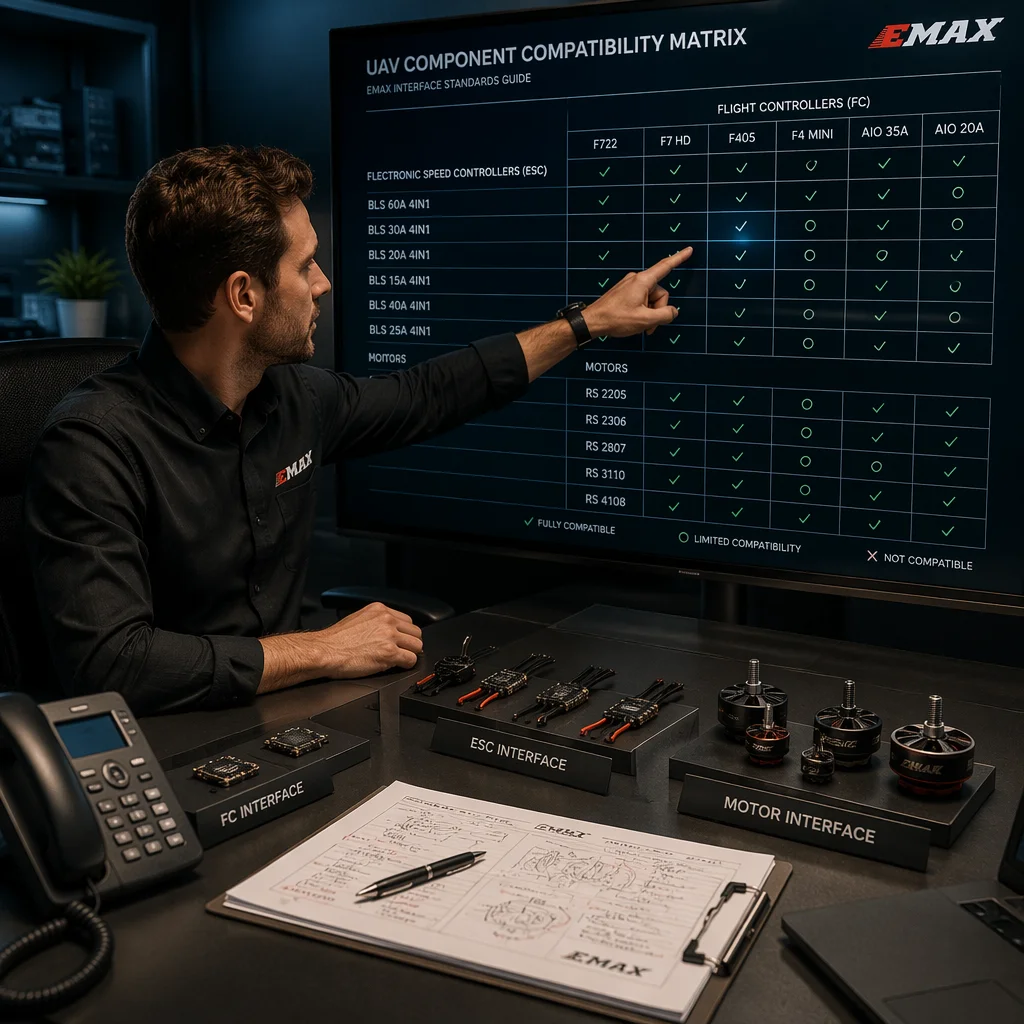
 Concept illustration
Frequently Asked Questions
Answers to the most common questions about UAV component sourcing, customization, ordering, shipping and technical support at EMS Drone.
What we supply and how to get started.
Questions about our component range, ordering process and configuration options.
 Concept illustration
What components do you supply?
Our scope covers flight controllers (FC), electronic speed controllers (ESC), motors, propellers, airframes, communication modules (radio, telemetry, GNSS), payload interfaces (cameras, gimbals, sensors) and complete configured aircraft. You can source a single component family, a matched subsystem stack or a full UAV platform. Every component is handled through incoming inspection and bench-level verification before reaching your build.
What is the minimum order quantity?
MOQ varies by component category and supplier. Many components support sample quantities — typically 1 to 5 units — for evaluation and prototyping. Production orders generally start at 10 to 50 units depending on the part. Complete-aircraft orders are reviewed per project. Exact MOQs are confirmed during the RFQ stage based on your selected configuration and build depth.
What are typical lead times?
Standard components held in stock typically ship within 5 to 10 business days after order confirmation and payment receipt. Configured subsystems requiring assembly and verification may take 2 to 4 weeks. Complete-aircraft builds — including integration, configuration and system-level testing — generally range from 4 to 8 weeks depending on complexity and customization depth. Every quotation includes a confirmed lead-time estimate that is updated throughout the order lifecycle.
Do you offer custom configurations?
Yes. Customization is central to the way we work. Share your mission requirements, payload, operating environment and target cost. We map the control, power, propulsion and communication architecture to your application, then configure individual components, firmware parameters and interfaces accordingly. You determine the build depth: a component BOM, a matched subsystem or a complete flight-ready aircraft.
Can you help with component matching?
Absolutely. Component matching is a core engineering service. If you know the aircraft type and mission profile but are unsure which flight controller works with which ESC, or which motor-propeller combination delivers the required thrust, share your brief. We will propose matched configurations with interface compatibility verified across the control, power and propulsion layers — so the stack works as a system, not as isolated catalog picks.
Commercial terms, payment and the RFQ process.
How to start an order, payment methods and what to expect during the commercial process.
What payment methods do you accept?
We accept international wire transfer (T/T), letter of credit (L/C) for larger production orders and selected trade assurance platforms. Standard payment terms are structured as a deposit (typically 30% to 50%) with order confirmation, with the balance due before shipment. Exact terms are negotiated per order and documented in the proforma invoice and sales agreement.
How do I start an RFQ?
Visit our contact page or use the inquiry form on any page. Share your project brief: aircraft type, payload, operating environment, component list if defined, target build depth and any interface or certification requirements. We will respond with a structured RFQ that maps your requirements to component and integration options, accompanied by pricing estimates and lead-time projections. The more detail you provide, the more precise the quotation.
Can I request samples before a bulk order?
Yes. Sample orders are supported for most component categories. Samples allow you to evaluate physical fit, connector compatibility, build quality and baseline performance before committing to production quantities. Sample pricing, lead time and shipping costs are confirmed per request. For custom-configured subsystems, a sample build may carry a modest engineering fee to cover configuration and documentation time.
Can you handle large-volume production orders?
Yes. We scale component supply and integration capacity based on confirmed order volumes. Production planning includes lead-time scheduling across multiple batches, batch-level quality control with serialized traceability, and staged delivery options if your project requires phased receipt. Volume pricing is structured per quotation and typically improves at higher quantities. Discuss your volume forecast during the RFQ stage so we can plan accordingly.
Delivery, testing, warranty and after-sales.
Questions about how we ship, what we test, and the support you receive after delivery.
Do you ship internationally?
Yes, we ship worldwide. Three shipping tiers are available: express courier (3 to 7 business days, door-to-door with tracking), air freight (5 to 12 business days, airport-to-airport or door-to-door for bulk orders) and sea freight (20 to 40 days, port-to-port for high-volume shipments). Every international shipment includes a complete export documentation package: commercial invoice, packing list, HS code classification and certificate of origin. See our shipping page for detailed packaging standards.
What testing is performed before shipping?
All components pass through incoming quality control: visual inspection for physical condition and connector integrity, electrical parameter checks against specification sheets, and documentation verification. Configured subsystems receive additional bench-level functional testing — signal measurement, communication protocol verification and firmware boot checks. Complete-aircraft builds undergo system-level integration testing. Test records are maintained per batch and are available for customer review upon request.
Do you provide technical support after delivery?
Yes. Technical support is available for component integration questions, firmware parameter guidance, interface troubleshooting and general system-level advice. Support scope and duration are defined per project and documented in the order. For complete-aircraft builds, we typically provide setup documentation, baseline parameter files and remote support during initial commissioning and first-flight preparation.
What is your warranty policy?
Standard warranty covers manufacturing defects for 12 months from delivery on electronic components and 6 months on mechanical parts including motors and airframe structures. Warranty terms vary by component category and are documented in the sales agreement. Warranty does not cover damage resulting from misuse, unauthorized modification, crash damage or improper installation. Return and replacement procedures are handled on a case-by-case basis with prompt communication throughout.
ODM/OEM, certifications and platform coverage.
Questions about manufacturing models, certifications and the types of platforms we support.
Do you offer ODM / OEM services?
Yes. We support both ODM (original design manufacturing) and OEM (original equipment manufacturing) engagement models. Under ODM, we design and build a UAV platform to your functional specification — you define the mission, we handle the architecture. Under OEM, we manufacture your existing design to your documentation and quality standards. Both paths begin with a detailed requirements conversation. Scope of work, intellectual property ownership and commercial terms are defined per project.
What certifications do your components have?
Many electronic components carry CE and FCC certification. RoHS compliance is available for most components in our catalog. Specific certification requirements — including region-specific radio compliance, material restrictions or industry standards — should be raised during the RFQ stage so we can confirm availability for your selected configuration. Our quality framework references ISO 9001, IPC workmanship standards and recognized testing methodologies, though EMS Drone is not an accredited testing or certification body.
What types of UAV platforms do you support?
Our component range supports multirotor, fixed-wing, VTOL and hybrid-configuration platforms. The specific component architecture — flight controller type, ESC protocol, motor sizing, propeller selection and airframe format — depends on the platform type combined with the mission profile, payload requirements and operating environment. Share your platform type and mission during the RFQ and we will recommend the appropriate control, power and propulsion stack for that configuration.
Ask us directly. Your question might not be on this page.
Share your project context and any specific question. We respond to every inquiry with relevant technical and commercial detail.