Every industry places different demands on the aircraft. We help you match the component architecture to the application — from inspection payloads to long-endurance mapping platforms.
Sectors5 Industry Groups
ApproachMission-First
DepthContext → Components
EntryApplication Brief
Mission-Driven Architecture
The application defines the aircraft, not the other way around.
An inspection drone flying close to a wind turbine blade needs different sensors, flight time, positioning accuracy and safety redundancy than a mapping drone covering square kilometers of farmland. Starting from the industry application ensures the component architecture is right for the job — not generic.
Concept illustration
Sector 01
Industrial Inspection
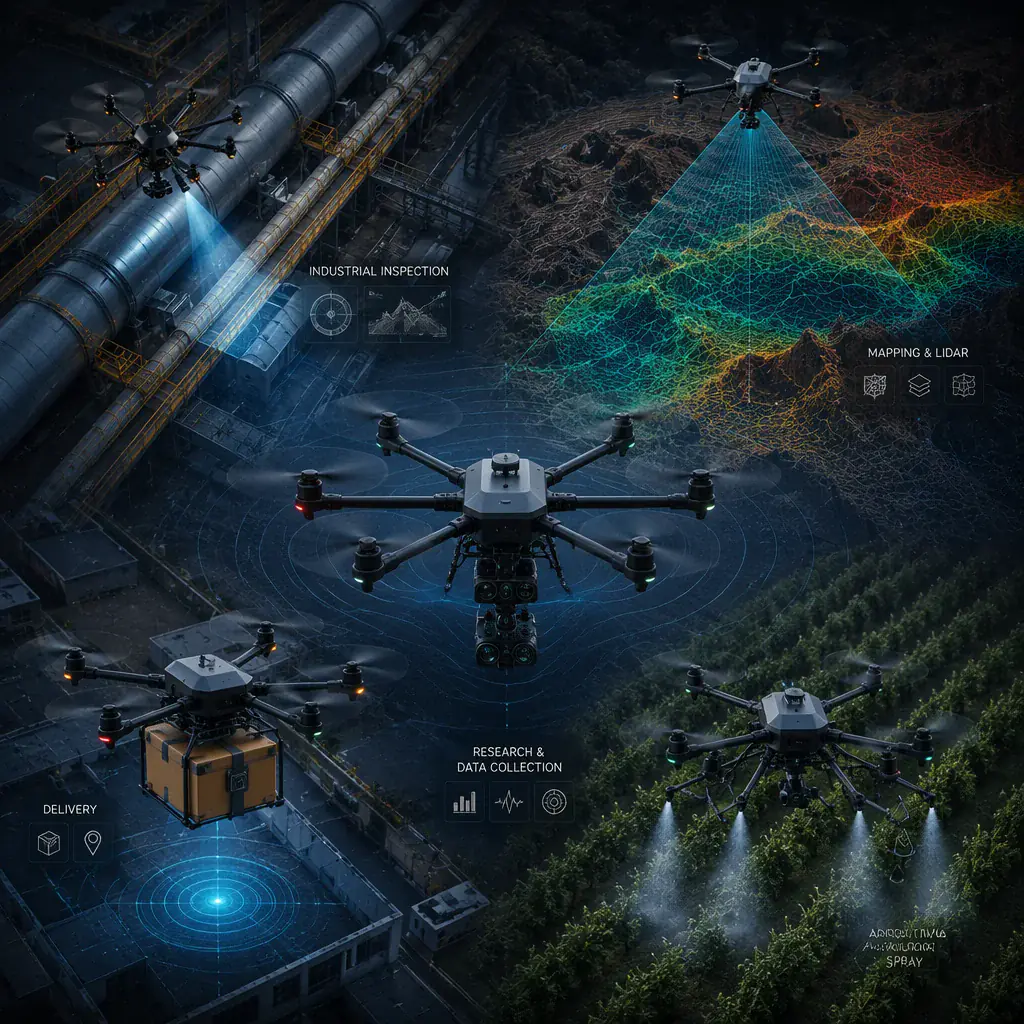
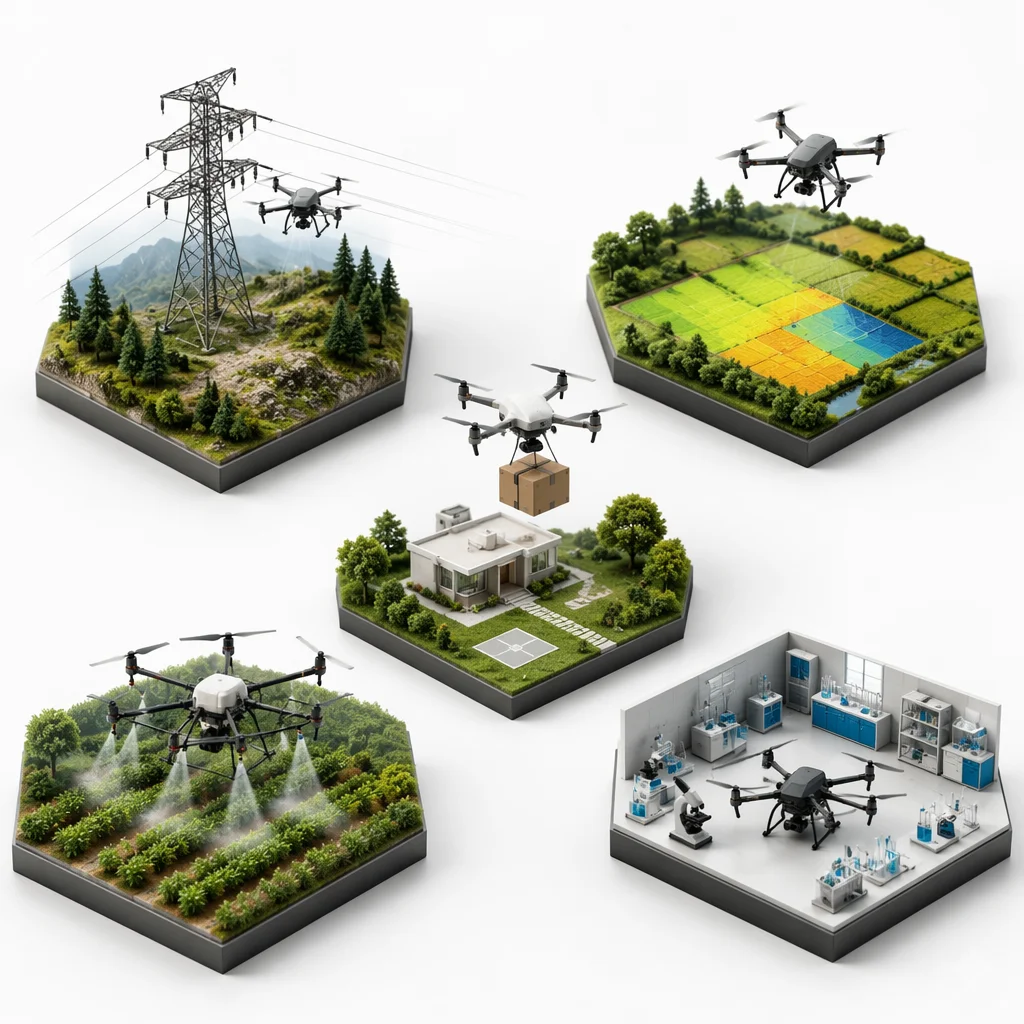
Aircraft that operate close to structures — wind turbines, power lines, pipelines, bridges, flare stacks and building envelopes. These applications demand precision position hold, high-resolution thermal and RGB payloads, collision-tolerant or caged designs for confined-space flight, and propulsion redundancy where operations occur near personnel or critical infrastructure. The component architecture prioritizes sensor payload integration, RTK positioning, and dual-operator control (pilot + camera operator) on a platform sized for 20–40 minute close-proximity missions.
Fixed-wing and multi-rotor platforms covering large areas for photogrammetry, topographic survey, volumetric measurement and corridor mapping. Endurance is the primary requirement — flight times of 60–120 minutes are common. The component architecture emphasizes efficient propulsion (low-KV motors, large propellers, Li-Ion batteries), high-resolution RGB or LiDAR payloads with precision geotagging, and reliable autonomous mission execution with terrain following. RTK GNSS is standard for survey-grade accuracy without ground control points.
Aircraft designed for payload transport — last-mile delivery, medical supply distribution, offshore vessel-to-platform transfer and warehouse-to-site logistics. The architecture centers on payload capacity and reliability: high-thrust propulsion with motor redundancy, payload release mechanisms with manual and automated trigger, robust communication links for beyond-visual-line-of-sight operation, and safety systems including parachute recovery and geofence-containment. Weight efficiency is critical — every gram of airframe weight is a gram of payload capacity lost.
Platforms for crop monitoring, precision spraying, seeding and livestock management. Two distinct sub-categories: lightweight multispectral mapping drones for crop health analysis (low payload weight, moderate endurance, automated grid flight) and heavy-lift spraying drones (10–30 L tank capacity, high thrust, low-altitude precision flight, corrosion-resistant components). The mapping side shares architecture with survey platforms. The spraying side is a distinct category with specialized pump, nozzle and tank integration requirements.
Configurable aircraft for universities, research institutions and R&D teams developing new UAV technologies, sensor payloads or autonomy algorithms. The priority is flexibility: open-architecture flight controllers (PX4 preferred), companion computer integration (NVIDIA Jetson, Raspberry Pi), accessible I/O for custom sensors, and modular frame designs that allow reconfiguration between experiments. Standard platforms include the Holybro X500 and custom-build 500–800 mm wheelbase quads with payload bays sized for development boards and prototype sensors. These are not production aircraft — they are research tools where modifiability and documentation matter more than optimized flight performance.
How industry requirements shape component choices.
Each application pushes different component families to the foreground. The table below shows which layers are most critical for each sector.
Industrial Inspection
Flight control (precision position, RTK GPS), payload (thermal + RGB), communications (dual-operator video link). Propulsion redundancy and collision-tolerant airframe are the differentiators.
Mapping & Survey
Propulsion (endurance-optimized motor-prop match), airframe (fixed-wing or efficient multi-rotor), payload (high-resolution camera or LiDAR with geotagging). Flight time is the dominant metric.
Logistics
Propulsion (high thrust-to-weight), ESC & power (high-discharge battery, robust distribution), airframe (payload bay, release mechanism). Reliability and payload fraction are the priorities.
Agriculture
Payload (multispectral or spraying system), flight control (automated grid patterns), airframe (corrosion-resistant materials). Spraying platforms add specialized pump and tank integration.
Research
Flight control (open architecture, companion PC), communications (flexible telemetry), airframe (modular, accessible). Documentation, expandability and modifiability are the key requirements.
Cross-Reference
Industry context translates into component architecture.
Each industry profile leads to a specific set of component requirements. Start from the application or start from the component — both paths converge on the same system view.
Capabilities Hub
Six component families, one system view
Browse the full component supply scope organized around system interfaces — flight control, power, propulsion, airframe, communications and payload.
Some industries need a single payload component. Others need a complete configured aircraft. The entry point depends on what already exists and what needs to be built.
01
Component
Source a specific part family — flight controller, motor set, payload sensor — for integration into an existing platform.
02
Matched Stack
Combine coordinated subsystems — FC + ESC + GPS, or motor + prop + ESC set — where interfaces are pre-verified.
03
Subsystem Kit
A complete functional block — full powertrain, full communication stack, or gimbal + camera + video link.
04
Platform Kit
Airframe + propulsion + power system pre-configured for a specific aircraft category and payload range.
05
Tuned Platform
Complete aircraft with configured flight controller parameters, PID tuning and bench-verified interfaces.
06
Mission-Ready
Flight-tested aircraft with configured payload, verified performance envelope and documented operational procedures.
Start With the Industry Context
Bring the application. We will map the architecture.
Tell us the industry sector, operational requirements, payload goals and target build depth. We will translate your application into a component architecture and integration plan.
Engineering Intake
Start with your mission.
Tell us what you are building and where you need support: component sourcing, a matched stack or a complete UAV.