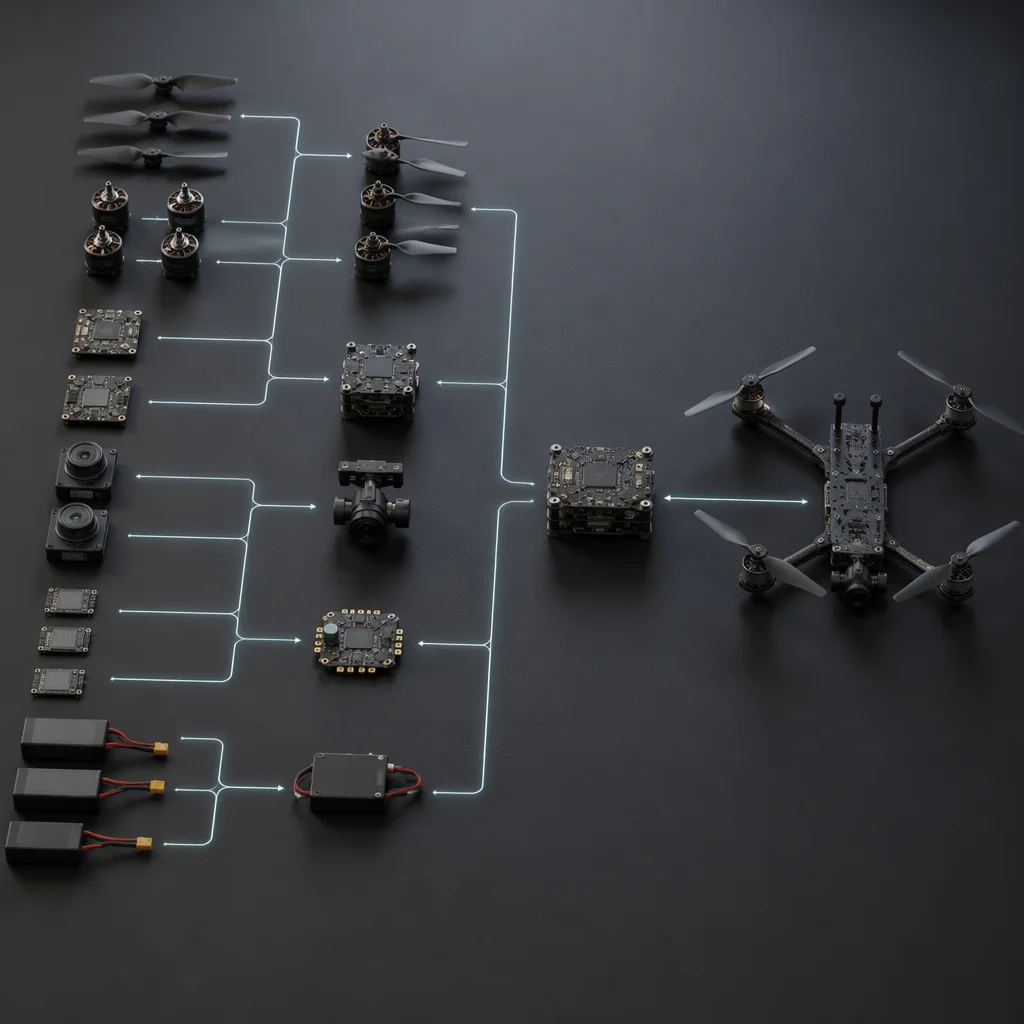
Procurement conversations about UAV hardware tend to start with a parts list. But the four-layer supply chain model suggests a better starting point: at which layer does your team have the engineering capacity to own integration? But the real decision is not which flight controller or motor — it is the sourcing depth. Choosing between individual components, matched subsystems and complete aircraft is a structural call that shapes your engineering budget, timeline and integration risk more than any single BOM line item.
The three sourcing depths
Every drone program operates at one of three levels — and the level you commit to determines how much engineering work stays on your side of the table.
- Individual components — source each part separately: flight controller, ESCs, motors, frame, radio, power distribution. Maximum flexibility in specification and BOM cost, but maximum engineering load. Your team owns every interface.
- Matched subsystems — buy pre-configured combos: an FC+ESC+motor stack that has been tested together, or a propulsion pack with known thrust curves. Reduced interface risk because the vendor already debugged the cross-layer connections. Moderate flexibility — you can still swap the airframe or payload.
- Complete aircraft — ready-to-fly or near-RTF platforms delivered as an integrated system. Minimum engineering overhead, minimum customization. The aircraft is a known quantity; your differentiation moves to the payload, data pipeline or operational workflow.
These are not just procurement categories. They are engineering capacity commitments. Moving one level deeper doubles or triples the number of interfaces your team must validate.
When individual components make sense — particularly after validating FC-ESC interface compatibility
Component-level sourcing fits teams with in-house integration capability and a mission profile that off-the-shelf platforms cannot cover. If your aircraft needs a specific thrust-to-weight ratio, unusual form factor, or IP-sensitive flight control architecture, buying at the part level gives you full control over the design space.
It also makes sense when BOM cost optimization matters more than time-to-deploy — for example, in production programs where shaving fifteen percent from per-unit cost justifies the upfront engineering investment. The trade-off is real: more decisions mean more chances for interface mistakes. A mismatched ESC protocol, an under-specced power distribution board, or a frame that leaves no clean harness path can each ground a build for weeks.
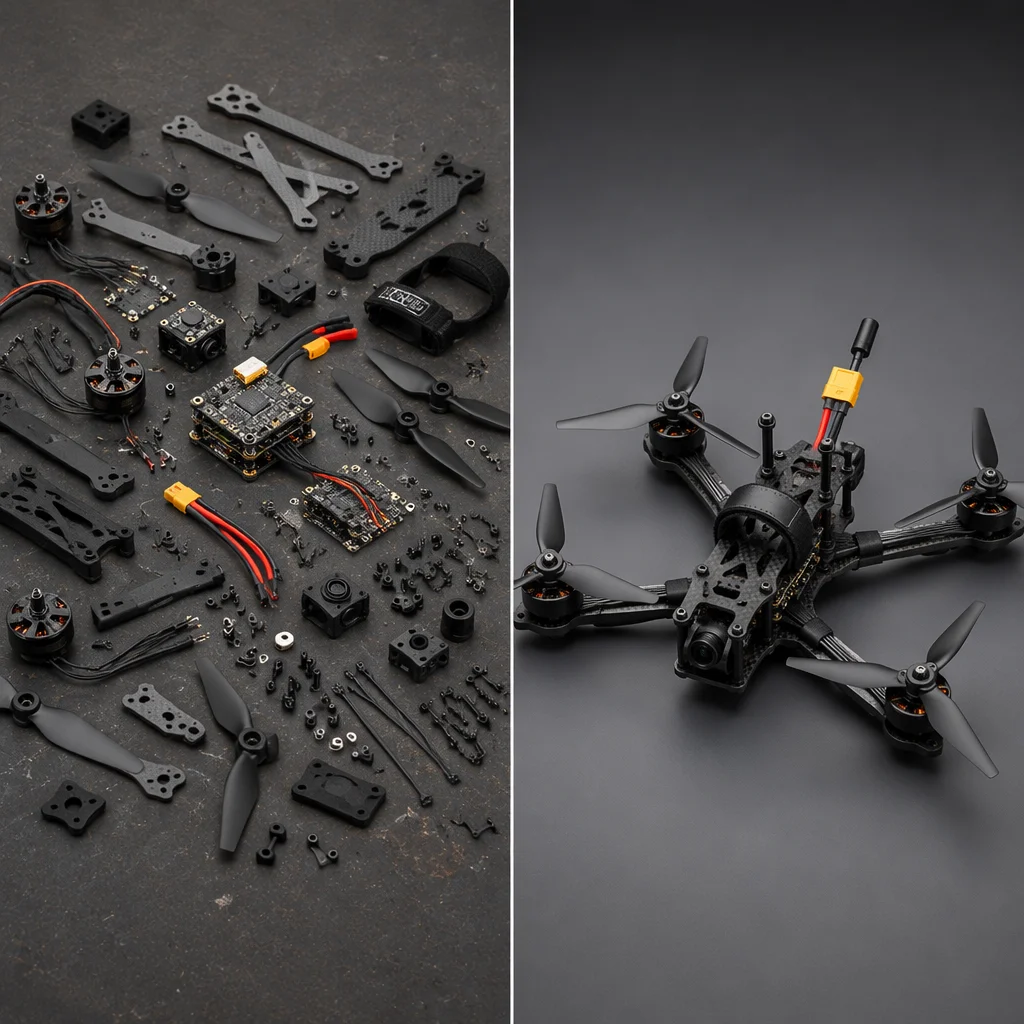 Concept illustration
When matched subsystems win — a pre-validated powertrain removes the hardest integration variable
Matched subsystems solve the interface problem at the layer level. A vendor selling an FC+ESC+motor stack has already tested the communication protocols, voltage ranges, connector pinouts and thermal behavior together. Your team integrates at the subsystem boundary rather than at every pin header.
This approach wins when time-to-deploy matters more than per-part cost optimization, when integration engineering bandwidth is limited, or when a proven stack already exists for your aircraft class. The propulsion subsystem for a 25 kg multirotor does not need to be invented from scratch — several vendors offer tested combinations with published performance data. You trade some BOM cost margin for dramatically lower debug time.
When a complete aircraft is the right answer
Complete-aircraft procurement is not a concession — it is often the fastest path to mission validation. If your team's core value is in the payload, the data pipeline, or the operational software, spending six months on airframe integration is a distraction rather than an investment.
This route also makes sense for rapid prototyping of the mission concept itself. Before committing to a custom airframe, flying the sensor package on a known platform answers the hard questions about altitude, endurance and data quality. And for programs requiring certification or airworthiness documentation, a pre-certified platform can save months of paperwork compared to certifying a bespoke build from scratch.
Hybrid approach: lock some layers, open others — airframe material decisions often sit on the "buy pre-fabricated" side while electronics stay flexible
Most real programs do not sit cleanly in one bucket. A common pattern: complete airframe with custom payload integration. Another: matched propulsion stack with a custom flight controller configuration for a unique control law. The skill is knowing which layers to lock early — the ones where interface risk is highest or where proven options exist — and which to leave open for differentiation.
A practical framework: lock the propulsion layer if thrust requirements are well-understood and off-the-shelf stacks exist. Leave the payload interface open if the mission sensor is still evolving. Lock the airframe if structural certification matters. Leave the flight controller configurable if control laws are proprietary. Each locked layer reduces integration surface; each open layer preserves room to compete.
Education, not a case study
This article is an industry primer on sourcing strategy. It does not describe a customer deployment, capacity claim or certified production outcome. Sourcing depth should be reviewed against your specific mission requirements, engineering bandwidth and program timeline.